
Investing in Our Future: Wastewater Treatment Plant Improvements
At the beginning of 2023, the City of Twinsburg Wastewater Department, in collaboration with Burgess & Niple (B&N), completed a preliminary design for the WWTP that included an in-depth analysis of existing conditions and a thorough evaluation of alternative designs for Equalization, Tertiary Treatment, and Disinfection. These efforts began with site visits to the Twinsburg WWTP, workshops with plant staff, and visits to observe the operation of other disc filter and UV equipment installations. This all culminated in the development of the preliminary design report. During the workshops between B&N and City staff, various options for improvements were discussed, concerns were identified, input was gathered, and consensus was built for the planned improvements. In mid-2023, the design phase of the WWTP Improvement Project commenced. The items included in the design are listed below. The design phase is nearly complete, and the bidding and funding phases are currently underway. Please see the attached timeline to learn about the next steps in the City of Twinsburg WWTP Improvement Project.
Below is a detailed list describing the different areas of the facility that will be improved as part of this project.
Wastewater Treatment Plant (WWTP) Improvement Project:
The $17 million WWTP improvement project includes adding Primary Equalization (EQ) improvements, Tertiary Treatment improvements, and Disinfection improvements. Please see a synopsis of each below.
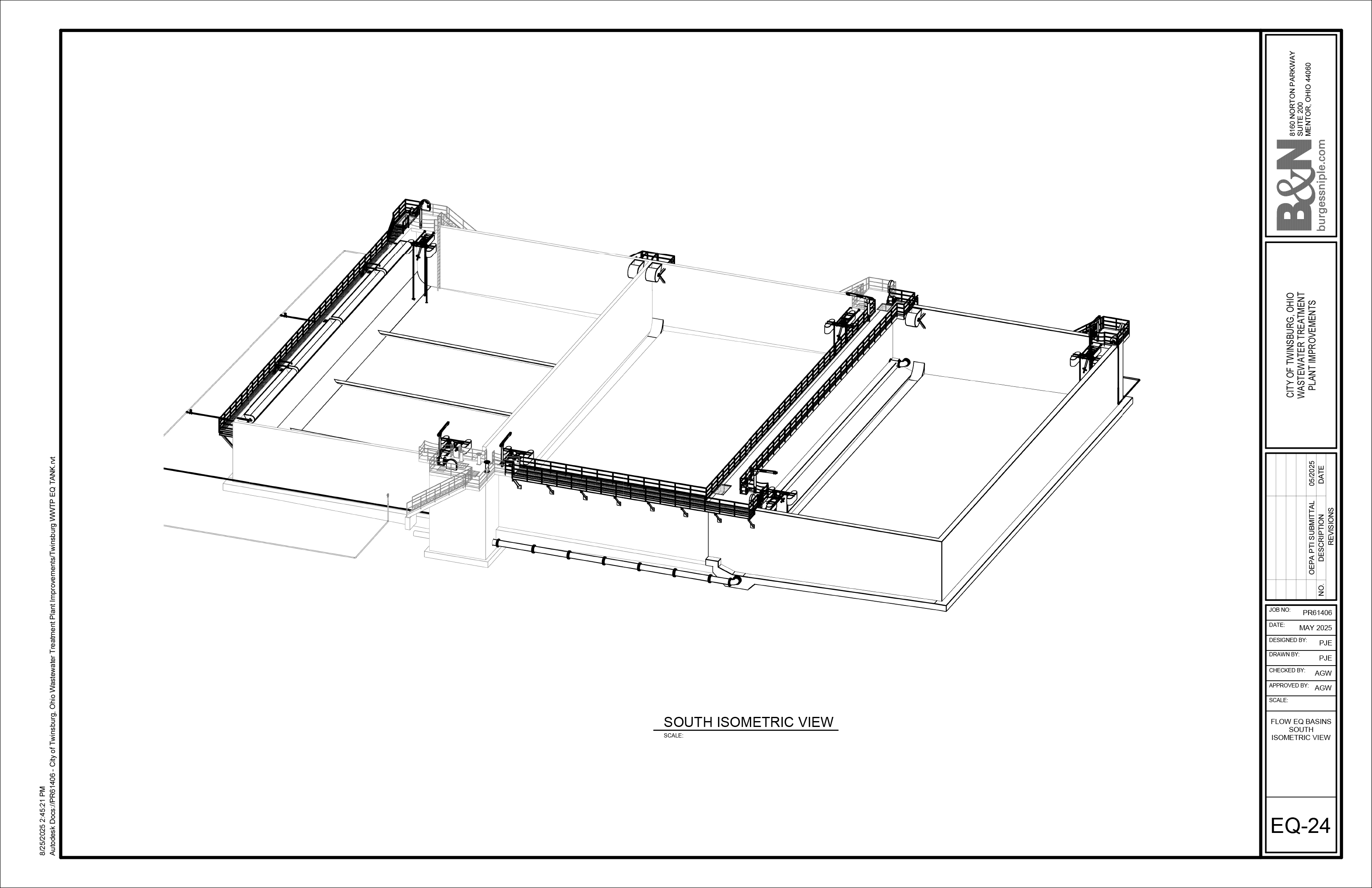
Equalization improvements: The project includes a new 130-foot-long by 64-foot-wide by 18-foot-deep 1-million-gallon flow equalization (EQ) basin, which will provide a total storage capacity of 3 million gallons. Other improvements involve enhancing cleaning operations with the use of tipping buckets, replacing the existing mixing system, adding a mixing system to the new EQ tank, a new influent/ isolation gate for Tank 3, replacing the Equalization Pumps, replacing the drain pump, and installing a new overflow in Tank #3 with level controls to totalize overflows. Project specifications are listed below.
- A third EQ basin will be constructed, adding 1 million gallons of storage capacity. It will be installed adjacent to EQ Tank No. 2.
- A new isolation gate will be installed. The existing isolation gates for EQ Tank #1 and #2 are in good condition and do not require replacement.
- Six new floating mixers will be installed, replacing old, out-of-date units.
- Tipping buckets in Equalization Tank No. 1.
- Tipping buckets in gutters of Tank No. 1, 2, & 3.
- New hose reels will be installed to assist with cleaning the tanks.
- Access stairs, walkways, and platforms for operation and maintenance.
- New valve for drain line.
- New drain pump to replace the existing.
- A new overflow weir will be installed in EQ Tank No. 3.
- A new ultrasonic level transmitter will be installed to be connected to the SCADA via the local PLC panel for real-time tank level monitoring, data logging, trending, and alarms.
- The existing four vertical turbine-type equalization pumps are to be removed. Three new dry pit submersible pumps with variable frequency drives are being installed.
- The existing MCC has reached its approximate useful life of 30-35 years, and many of the components (i.e., breakers, contactors, transformers, etc.) may be worn beyond the manufacturer’s recommended limits. The improvement includes new PLCs and MCCs.
- The existing unit heater will remain. The improvements include replacing the existing blower/exhaust fan and ductwork with new equipment to meet the heat generated from the new pumps and VFDs.
- New lighting will be provided.
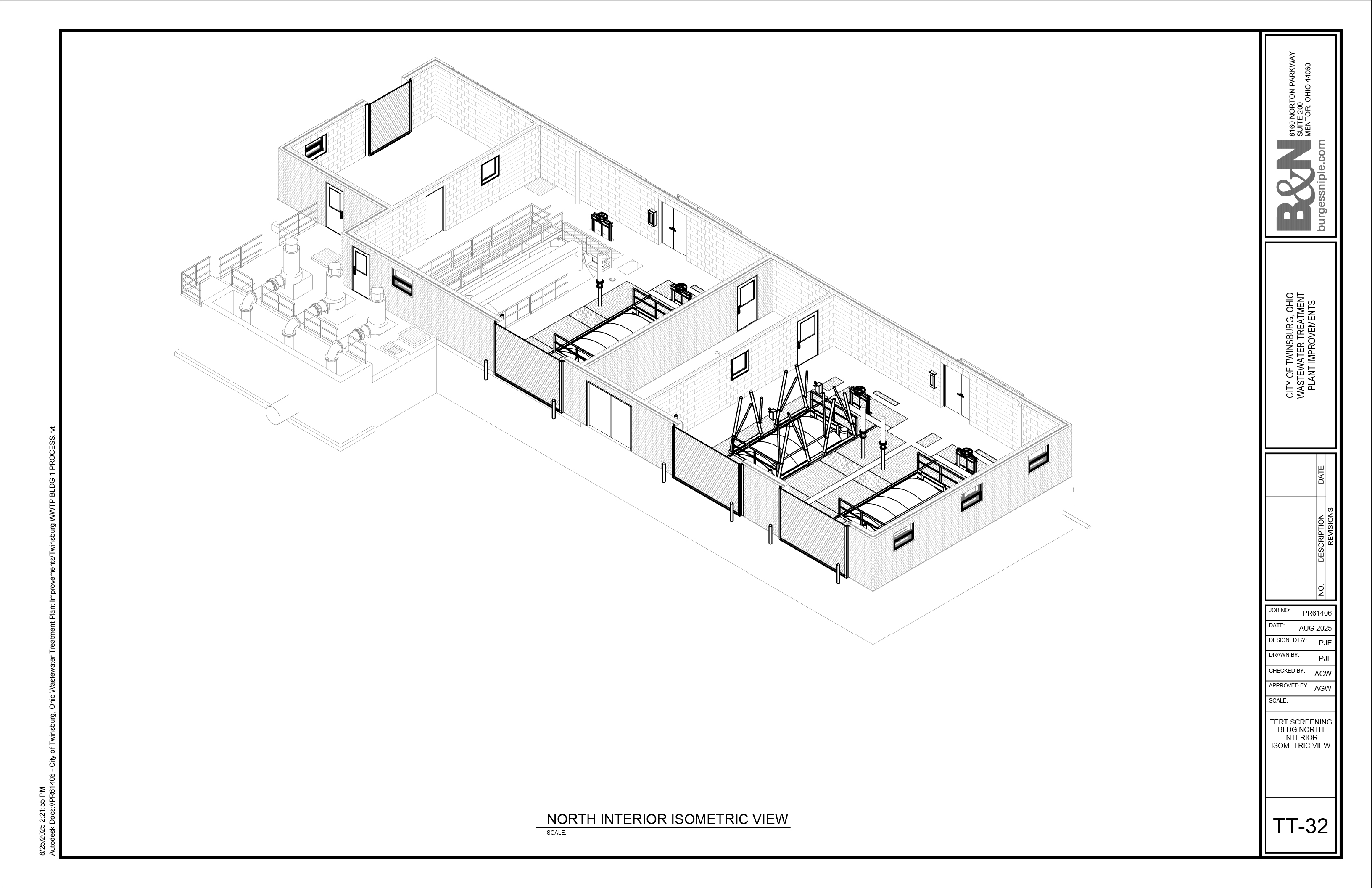
Tertiary Treatment improvements: The project includes installing new disc filter equipment to replace the existing Microstrainers, which are past their useful life and increasingly challenging to repair. The new disc filters can handle peak flow even if one of the three disc filters is out of service. The City has chosen to keep Microstrainer No. 1 for manual operation during emergencies. The design will upgrade the existing facility with new equipment and perform necessary building improvements to meet code, thereby streamlining the maintenance and operation of the disc filters in the future. The project also includes replacing the existing non-potable water pumps located in the disc filter effluent basins. In the Tertiary Building, the project involves installing new disc filter equipment to replace the existing microstrainers, which have reached the end of their useful life and are increasingly challenging to repair. The new disc filters can handle peak flow even if one of the three disc filters is out of service. Project specifications are listed below.
Selective demolition will be performed to remove existing microstrainers, backwash pumps, mixer, associated piping, valves, appurtenances, and non-potable water system.
Three new disc filters will replace the three original units. The new units are inside-out flow type rated at five gallons per minute per square foot, with one unit out of service. The design includes keeping Microstrainer #1 installed for emergency use with parts salvaged from the demolition of Microstrainers #2, #3, & #4.
New isolation gates for new disc filters will be installed.
A new grating system of the diamond plate type will be installed.
Pre-screening to protect disc filters will be installed.
A chemical cart for a clean-in-place system will be installed for the disc filters.
A new gantry crane system will be installed for future maintenance of disc filters.
Building improvements, including new overhead doors for O&M, roof replacement, doors, windows, lighting, hardware, concrete repair, masonry pointing, painting, etc.
The non-potable water system pumps will be replaced with submersible pumps sized for future plant water demands. This also includes miscellaneous piping and valves.
HVAC and plumbing upgrades.
The new disc filters would have their own control panels housing the required VFDs, starters, PLCs, and controls. The new NPW pumps will also have VFDs.
The existing turbidity meter is being replaced in kind.
The new disc filters control panels PLCs will be connected to the existing plant-wide SCADA system via the local PLC panel/switches (Ethernet or data highway) for monitoring, data logging, alarms, trending, etc. functions.
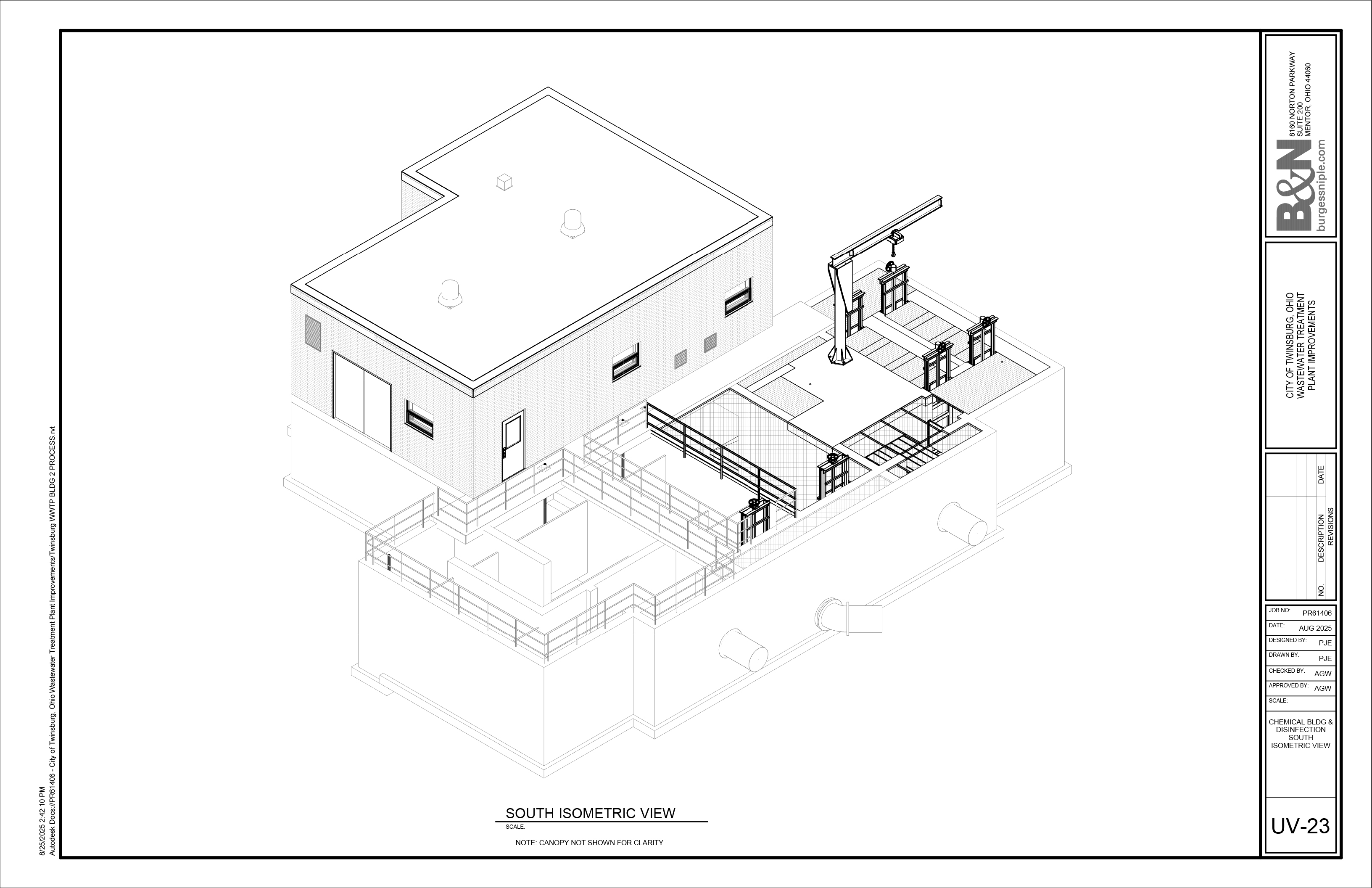 Disinfection improvements: The project includes the replacement of the current chlorine gas and sodium bisulfite disinfection system with a Ultra Violet (UV) disinfection treatment system. Retrofitting of control panels for the UV systems will also be installed. A large crane and cover will be installed to protect the equipment from the sun’s UV rays and aid in the removal of the units when needed. UV transmittance testing was conducted to confirm that replacing the current chlorine gas and sodium bisulfite disinfection system with UV disinfection is a viable option. After evaluating the equipment, the City conducted site visits to existing WWTPs with UV disinfection. Plant staff determined that retrofitting within the existing contact tanks was more suitable for operation and maintenance with a vertical UV system. During detailed design, various options were evaluated for covering the existing chlorine contact tank, and a canopy structure is planned. The adjacent Chemical Building will be modified to accommodate a new Electrical Room. Project specifications are listed below.
- Selective demolition will be performed to remove the existing chlorine gas feed system and sodium bisulfite system.
- Tank, wall, and floor modifications will be made to accommodate the installation of the new UV disinfection equipment into the existing channels.
- New Vertical UV Disinfection Equipment will be installed, complete with vendor-supplied control panel PLCs.
- The new UV control panel PLC will be connected to the existing plant-wide SCADA system via Ethernet/data highway/fiber for monitoring, data logging, alarms, trending, etc. functions.
- New grating and a canopy system will be built over the existing chlorine contact tank to minimize algae growth and provide a covered work environment for plant staff.
- New radar level sensors will be installed to calculate the effluent flow rates.
- Structural repairs to the outfall sampling stairs will also be made for operator safety and accessibility.
Building/ Other Improvements: The tertiary Building will receive a new roof, new doors, and a new generator will be installed. It will be sized to meet the requirements of this project and also to accommodate a future planned upgrade project for electrical gear, distribution, and MCC. The outfall steps will also be renovated. Project specifications are listed below.
- The existing 475 kW indoor generator will be removed completely.
- A new 1,000 kW diesel generator sized for future demands will be installed. An access platform will be provided. The generator will be located on an equipment pad, with the fuel tank positioned underneath the generator set.
- Building improvements include new lighting, roof replacement, modifications for a new UV Electrical Room, doors, windows, hardware, concrete repair, masonry pointing, painting, etc.
- HVAC and plumbing upgrades will also occur.
Funding: The funding source for this improvement project is the Ohio Environmental Protection Agency, Division of Environmental and Financial Assistance (OEPA-DEFA) Water Pollution Control Loan Fund (WPCLF). This revolving loan program is administered through the Ohio Water Development Authority (OWEA). The City currently has a design loan for this project that will be rolled into the Construction Loan. The City renominated the WPCLF Construction Loan in September 2025. The project will be funded using a low-interest 30-year loan through the listed agencies. With this project and future planned repairs to City-owned sanitary assets, an increase in the sewer rates was necessary to update WWTP equipment as well as sanitary sewer systems to continue to provide sanitary services to the community and meet Ohio Environmental Protection Agency discharge requirements.
